Primary keyword: how to use iptv | Target: ~2,000 words | Published on Natixtv
You finally cut the cord. The cable box is gone, the satellite dish is down, and you’ve signed up for an IPTV subscription that promises thousands of channels, movies on demand, and a live program guide right on your screen. Then you open the app for the first time and… pause. Where do you even begin? If that moment sounds familiar, you are not alone. Knowing how to use IPTV properly is what separates a frustrating experience from a genuinely great one. IPTV USA platforms like Natixtv are built to make this easy, but a quick orientation goes a long way.
Think about the last time you discovered a shortcut that changed how you used something everyday. That’s exactly what this guide is here to do for your IPTV setup. Whether you’re navigating channels, reading the electronic program guide, building your favorites list, or diving into a VOD library full of films, each feature has a logic to it. Once you get it, everything clicks.
This IPTV guide covers every core feature you need to master, step by step, in plain language. No jargon, no fluff. Just the information you need to actually enjoy what you’re paying for.
Table of Contents
What Is IPTV and How Is It Different from Regular TV?
IPTV stands for Internet Protocol Television. When you learn how to use IPTV, you’re essentially learning to stream TV over your internet connection instead of receiving a signal through a cable or satellite dish. That shift unlocks features that traditional TV simply cannot offer: a built-in program schedule, a library of on-demand content, the ability to pause live TV, and a fully personalized channel list.
If you’re curious about how the technology has evolved and why providers are raising the bar on streaming quality, this deep dive into how modern streaming services are reshaping the viewing experience is worth a read.
Here’s a quick comparison to put it in perspective:
| Feature | IPTV | Cable TV | Satellite TV |
|---|---|---|---|
| EPG (Program Guide) | Built-in, real-time | Basic grid | Basic grid |
| VOD / On-Demand | Yes, extensive | Limited | Rare |
| Multi-device support | Yes | No | No |
| Favorites management | Yes | No | No |
| Catch-up TV | Yes (24-72 hrs) | Rare | No |
| Pause or rewind live TV | Yes | Rare | No |
| Internet required | Yes | No | No |
The gap is significant. IPTV is not just a different delivery method. It is a fundamentally richer way to watch television, provided you know how to use each feature effectively.
How to Navigate IPTV Channels Without Getting Lost
One of the first things people notice about IPTV is the sheer volume of channels. Depending on your plan, you could be looking at anywhere from a few hundred to several thousand. Without a strategy, scrolling through that list becomes exhausting fast.
Understanding How Channels Are Organized
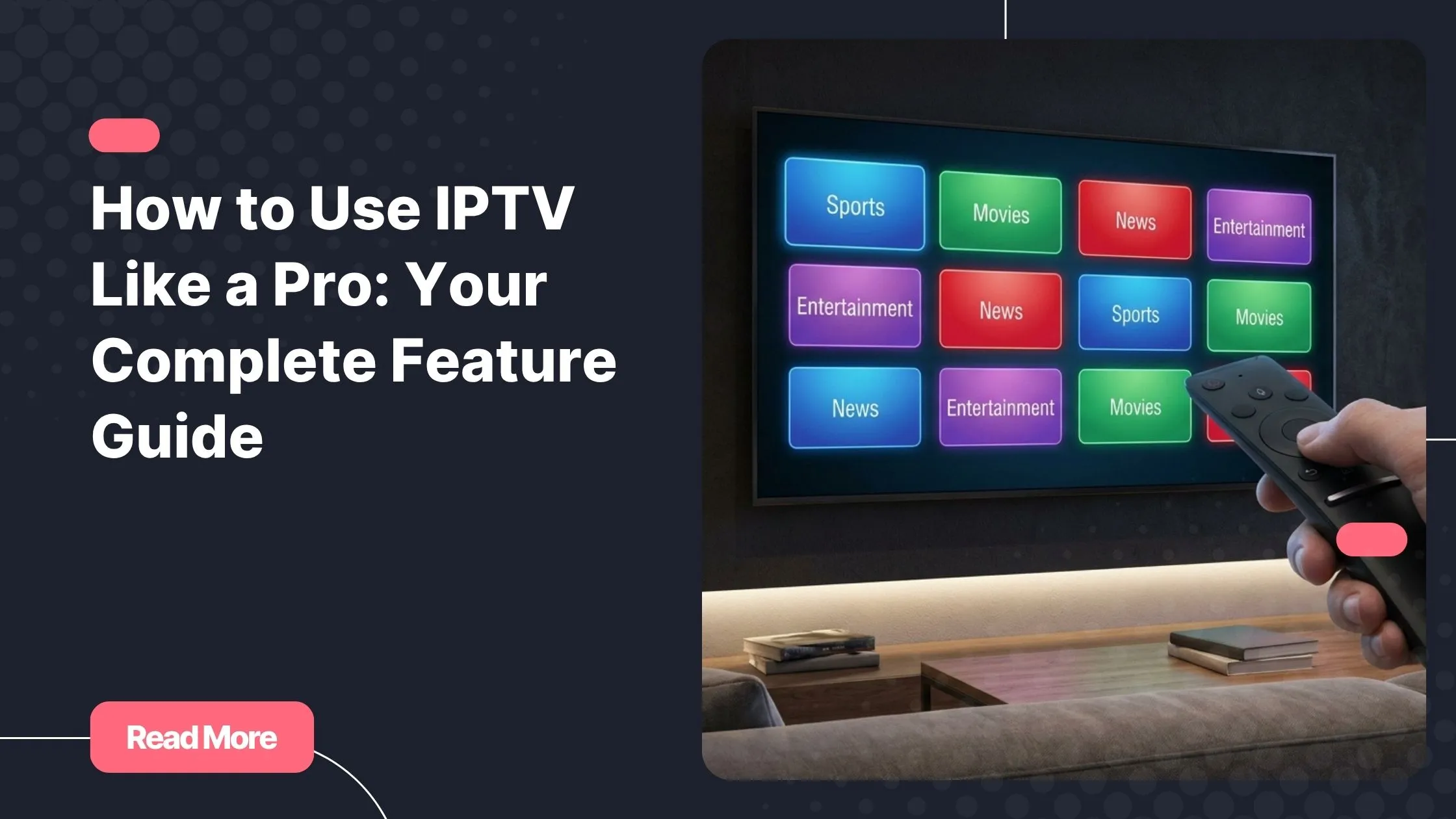
Most IPTV players organize channels into groups or categories. You’ll typically find sections for sports, news, entertainment, movies, kids, and international content. Some providers also organize by country or language, which is helpful if you’re looking for content from a specific region.
Inside your app, look for a “Groups” or “Categories” tab in the main menu. Selecting a category narrows the list dramatically and makes browsing much faster.
Using Search to Find Channels Quickly
Every quality IPTV app includes a search function. Use it. Instead of scrolling through 2,000 channels to find ESPN or CNN, type the name and get there in two seconds. On Fire TV Stick or Android devices, voice search makes this even faster.
Tips for Smooth Channel Switching
- Use a stable internet connection with at least 10-15 Mbps for HD channels.
- On apps like TiviMate, you can enter a channel number directly for instant access.
- Reduce background apps on your device to free up processing power.
- If you experience delays when switching channels, try reducing the stream quality to FHD instead of 4K unless your connection is strong.
Knowing how to use IPTV channels efficiently starts with learning the layout of your specific app. Spend a few minutes exploring the menus when you first install it. That initial investment saves hours of frustration later.
How to Use the IPTV EPG (Electronic Program Guide)
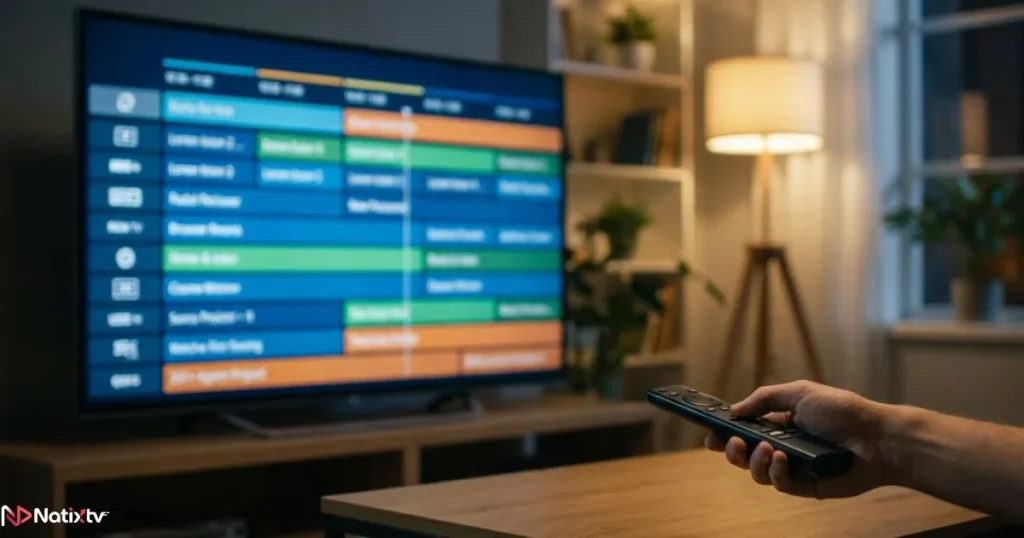
The IPTV EPG is one of the most powerful and underused features in any IPTV setup. Think of it as a digital TV guide built directly into your app, showing you what’s on right now and what’s scheduled for the hours ahead.
What the EPG Shows You
When you open the EPG view in your IPTV player, you’ll see a grid: channels on the left, time slots across the top, and program titles filling in the blocks. You can scroll forward to see upcoming shows, click on a program to read its synopsis, and in some apps, set a reminder so you don’t miss it.
The EPG is typically updated every 24 hours by your provider, using a data format called XMLTV. This means the schedule you see reflects real broadcast times, not estimates.
How to Read and Navigate the EPG
Most apps offer two EPG display options: a timeline view (the full grid) and a list view (programs for one channel at a time). The timeline view is better when you’re browsing across channels. The list view is better when you already know the channel and want to plan your viewing for the day.
To navigate the EPG on a remote or keyboard, use the arrow keys to move between channels and time slots. Clicking or pressing “OK” on a currently airing program switches to it immediately. Pressing “OK” on a future program opens its detail screen.
What to Do When EPG Data Is Missing
Sometimes a channel shows up in your list but has no EPG data attached. This usually happens for smaller regional channels. If you notice a lot of missing EPG information across major channels, try these steps:
- Force-close and reopen your IPTV app to trigger a refresh.
- Go into your app settings and look for an “Update EPG” or “Refresh Guide” option.
- Check that the EPG URL in your app settings matches what your provider gave you.
- If the issue persists, contact your IPTV provider’s support team.
A well-functioning IPTV EPG transforms casual channel surfing into intentional, scheduled viewing. It’s one of those features that once you rely on it, you can’t imagine going back to blind channel flipping.
Managing Your IPTV Favorites: Build Your Personal Lineup
Here’s the truth about IPTV navigation: you won’t use 90% of the channels in your list. What you actually watch is probably a core group of 20 to 40 channels. Favorites let you build a lean, personal lineup of exactly those channels, so you’re never digging through the full list again.
How to Add Channels to Your Favorites
The process is slightly different between apps, but the logic is the same everywhere:
- Open your full channel list.
- Find the channel you want to save.
- Long-press it (on mobile or Fire TV) or right-click it (on PC).
- Select “Add to Favorites” from the context menu that appears.
- The channel now appears in your Favorites tab at the top of your channel list.
On TiviMate, you can also create multiple custom groups, not just a single favorites folder. This is useful if you want to separate your sports channels from your news channels from your international content.
Best Practices for a Clean Favorites List
- Keep the list under 40 channels so it loads quickly and stays scrollable.
- Review and update it every few months, especially around sports seasons.
- Back up your M3U playlist file or save your Xtream Codes credentials in a secure place. If you reinstall the app, your favorites may reset.
- On apps that support drag-and-drop reordering, put your most-watched channels at the top.
Understanding how to use IPTV favorites effectively is one of the fastest ways to improve your daily experience. It turns a massive, overwhelming library into something that feels personal and instantly usable.
IPTV VOD: How to Access and Enjoy On-Demand Content
IPTV VOD is the on-demand library included with most IPTV subscriptions. Unlike live channels, VOD content is available anytime. You pick it, you play it, you control it. It’s the closest thing to having Netflix built into your IPTV service.
Browsing the VOD Library
Your app’s VOD section is usually separated from the live channel list. Look for a “Movies,” “Series,” or “Video on Demand” tab in the navigation menu. From there, you can browse by genre (action, drama, comedy, documentaries), filter by year or language, or use the search bar to find a specific title.
Most providers include thousands of titles in their IPTV VOD libraries. Quality varies: some entries are in SD, others in HD or FHD. Check the label on the title or the stream quality indicator before playing if bandwidth is a concern for you.
Catch-Up TV vs. VOD: Understanding the Difference
| Feature | Live TV | IPTV VOD | Catch-Up TV |
|---|---|---|---|
| Content type | Real-time broadcast | Pre-recorded library | Recent past broadcasts |
| Available when | Scheduled only | Anytime | Within 24-72 hours |
| Pause or rewind | Limited | Full control | Full control |
| EPG integration | Yes | No | Partially |
Catch-up TV is specifically for broadcasts that have already aired on a live channel. If you missed the game last night, catch-up lets you access the recording through the EPG or a dedicated catch-up menu, typically for up to 72 hours after broadcast.
Getting the Best Streaming Quality from VOD
For smooth VOD playback, aim for at least 15 Mbps for FHD content and 25 Mbps or more for 4K. If you’re unsure about your current speeds, Speedtest by Ookla is the most reliable free tool to measure your real download and upload performance before troubleshooting any streaming issue. If you’re on a slower connection, choose HD rather than FHD to avoid buffering interruptions. Most IPTV apps let you manually select the stream quality in the playback settings.
If your VOD content buffers frequently, check whether your connection speed is the bottleneck or whether the issue is server-side. Switching to a wired Ethernet connection rather than Wi-Fi is often the single biggest quality improvement you can make. If you’re using a VPN to protect your stream, make sure it’s one optimized for IPTV, as the wrong VPN can add significant latency. This guide on choosing a VPN that won’t hurt your IPTV stream quality is a solid reference.
Choosing the Right IPTV App for Your Device
The app you use has a big impact on how enjoyable your IPTV experience is. A great app makes features like the EPG, VOD browsing, and favorites feel seamless. A poor one makes everything a struggle.
Best IPTV Apps by Device
- Android or Fire TV Stick: TiviMate (premium), IPTV Smarters Pro, GSE Smart IPTV
- iPhone or iPad: GSE Smart IPTV, IPTV Smarters
- Samsung or LG Smart TV: Smart IPTV, SS IPTV
- PC or Mac: VLC Media Player, Kodi with an IPTV plugin
- MAG Box: uses a built-in Stalker portal interface
What to Look for in a Good IPTV Player
- EPG support with a clean, scrollable grid view
- Multiple playlist or group management options
- External player compatibility (VLC or MX Player for tricky codecs)
- Regular app updates that address bugs and improve performance
- Parental controls if you have children in the household
Knowing how to use IPTV on a specific device often comes down to picking the right app first. If TiviMate is available on your device, it’s generally the top choice for its clean UI, robust EPG, and multi-profile support.
Troubleshooting the Most Common IPTV Problems
Even the best IPTV setups hit occasional bumps. Part of knowing how to use IPTV confidently is understanding how to fix the small issues that come up from time to time. Here’s how to handle the ones you’re most likely to encounter.
Buffering and Freezing
Buffering is almost always a connection issue. Run a speed test first. If your speed is above 15 Mbps, try switching to a wired connection or moving closer to your router. If buffering only happens on specific channels, those streams may be overloaded server-side. Contact your provider.
EPG Not Loading
Clear your app’s cache, force-close it, and reopen it. If that doesn’t work, go to your IPTV app settings and manually trigger an EPG refresh. Verify the EPG URL is exactly what your provider sent you, with no added spaces or characters.
Channels Not Playing
- Check that your subscription is active and hasn’t expired.
- Verify your M3U URL or Xtream Codes credentials are entered correctly.
- Try opening the stream in an external player like VLC to rule out a codec issue.
- If only some channels are broken, report the specific channel names to your provider.
Most issues that come up when you’re learning how to use IPTV are easy to resolve with these steps. If a problem persists, a responsive provider’s support team is your best next resource. With IPTV USA services like Natixtv, support is accessible and the platform is optimized to minimize these issues from the start.
Frequently Asked Questions
How to use IPTV for the very first time?
Start by subscribing to a provider (like Natixtv), downloading a compatible app on your device (TiviMate or IPTV Smarters Pro are solid starting points), and entering your credentials: either an M3U URL or Xtream Codes login details. Once connected, your channel list, EPG, and VOD library load automatically. Explore each section for a few minutes before settling in.
What is the IPTV EPG and do I need it?
The IPTV EPG is an electronic program guide embedded in your app. It shows real-time schedules for every channel in your lineup. You don’t strictly need it, but once you start using it, you’ll wonder how you managed without it. It’s especially useful for sports fans and anyone who watches scheduled programming.
How do I access IPTV VOD content?
In your IPTV app, look for a dedicated VOD, Movies, or Series tab in the main navigation. From there, browse by genre or search by title. Click on any entry to start streaming. Playback controls (pause, rewind, fast-forward) work the same as any streaming service you’ve used before.
How to use IPTV on a Smart TV?
Install a supported app from your TV’s app store. Samsung users can try Smart IPTV, and LG users can use SS IPTV. Once installed, open the app, enter your M3U URL or Xtream Codes credentials, and navigate with your remote. The experience is very close to what you’d get on a Fire TV Stick or Android box.
Can I use IPTV on more than one device at the same time?
That depends entirely on your subscription plan. Many providers offer multi-connection plans that allow two or more simultaneous streams. Check with your provider about upgrading your plan if you want to watch on multiple devices at once without interruption.
How to use IPTV without buffering?
Use a wired Ethernet connection whenever possible, aim for at least 15 Mbps for HD streams, and avoid using a VPN unless it’s one specifically optimized for streaming. If buffering still occurs, ask your provider about alternative server options, as load balancing can make a significant difference.
Conclusion: Make IPTV Work the Way You Want It To
Learning how to use IPTV is less about technical knowledge and more about spending a little time exploring what your setup can do. Navigate your channels, build your favorites list, get comfortable with the EPG, and dig into the VOD library. Each of these features is designed to give you more control over what you watch and when.
The more you personalize your IPTV experience, the more natural it becomes. Within a week, you’ll be navigating faster than you ever did with a cable box.
Ready to get started?
IPTV USA provider Natixtv offers subscriptions compatible with every major device: Smart TVs, Fire TV Stick, Android, iOS, MAG boxes, and more. All the features covered in this guide, including the full EPG, VOD library, favorites management, and catch-up TV, are included with every plan. And if you’re not sure yet, Natixtv offers a free trial period of 24 to 48 hours so you can test everything before you commit. No pressure, no risk.